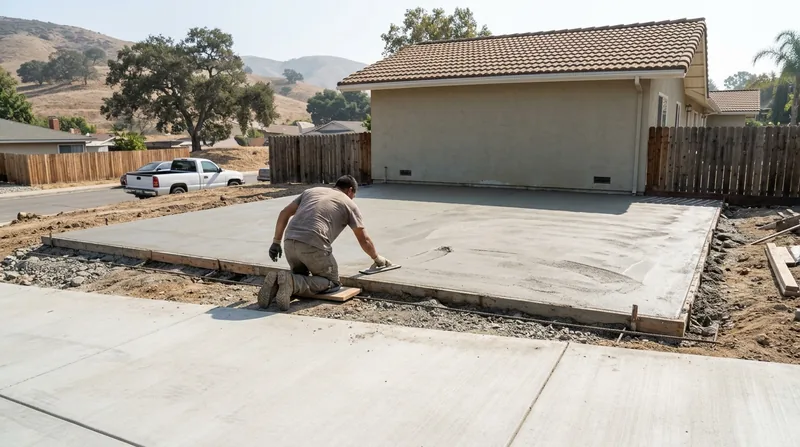




Thousand Oaks sits in the Conejo Valley, where rolling oak-studded hills rise toward the volcanic peaks of Boney Mountain and the Santa Monica Mountains. The terrain here is dominated by expansive adobe clay over volcanic and sedimentary bedrock, a geology that swells dramatically in wet winters and shrinks during the long, dry summers. This cycle causes concrete slabs to crack, heave, and settle unless they rest on a properly prepared subgrade with engineered drainage. Whether you are building a new garage foundation in the 1970s ranch tracts of Conejo Oaks, a room addition on a hillside lot in North Ranch, or a shed foundation on a sloped pad in Dos Vientos, concrete slabs and foundations in Thousand Oaks must be designed and installed to handle the valley's unique soil behavior and intense summer sun. We pour engineered slabs with proper thickness, steel reinforcement, and compacted base preparation so your structure stays level and stable for decades. Learn more about our approach at our homepage.
Why Concrete Slabs and Foundations Matter in Thousand Oaks' Clay and Hillside Terrain
The Conejo Valley's adobe clay foundation is a double-edged sword. It is stable when dry but becomes unpredictable during heavy winter rains and the spring thaw that follows. Slabs poured on inadequate subgrades or without proper drainage fail within 5 to 10 years, cracking in diagonal patterns or heaving unevenly. Hillside lots add slope creep and runoff, which erode subgrades and destabilize footings. A slab that looks solid in October may show stress fractures by March. The intense summer heat and UV exposure fade sealers and accelerate concrete deterioration if the base work was rushed or incomplete.
- Improper subgrade preparation allows water to pool under slabs, causing clay to swell and lift concrete unevenly.
- Undersized or missing reinforcement steel causes slabs to crack under the weight of vehicles, equipment, or structural loads.
- Sloped terrain without engineered drainage channels water directly under footings, eroding soil and creating voids.
- Summer heat and Santa Ana winds can cause fresh concrete to set too fast, trapping air pockets and weakening the final surface.
A properly engineered slab with compacted base, correct thickness, and reinforcement stops these failures before they start.
Key info: Thousand Oaks homeowners in North Ranch, Lang Ranch, and Sunset Hills often discover failed slabs only after heavy rains expose heaving or cracking. Getting a slab engineered and poured correctly the first time costs less than demolition and replacement later. See the removal and replacement service if you are dealing with a failed slab now.
For detailed permitting guidance specific to Thousand Oaks, the City of Thousand Oaks Development Services page outlines setback requirements, driveway width limits, and curb-cut procedures for new concrete work.
How We Pour Concrete Slabs and Foundations in Thousand Oaks: Our Process
We begin every slab project with a site assessment that accounts for soil type, drainage patterns, slope, and the load the slab will carry. On clay-heavy lots in Thousand Oaks, we compact the subgrade in layers, install drainage rock and perforated pipe to direct water away, and specify concrete thickness and rebar placement based on the intended use. We pour during cool early mornings or late afternoons to avoid the fast set times that occur during peak summer heat. The slab cures under protection, and we finish the surface to the client's specifications, whether that is a smooth trowel, a broom finish for traction, or a stamped or colored design.
- We excavate to proper depth, removing loose soil and debris down to stable subgrade material.
- We install a compacted gravel base in 4-inch lifts, tamping each layer to achieve 95 percent standard Proctor density.
- We lay reinforcement steel (rebar or wire mesh) at the correct elevation to provide tensile strength throughout the slab.
- We set forms to grade, check for level and slope, and pour concrete to the specified thickness, typically 4 to 6 inches for residential work.
- We finish the surface, control joints, and protect the curing concrete from rapid drying and temperature shock.
This methodical approach ensures your slab stays flat and crack-free even as the Thousand Oaks clay cycles through wet and dry seasons.
Example: A homeowner in Westlake Village needed a foundation for a new guest house on a hillside lot. We identified a seasonal drainage swale upslope, installed a perforated drain line to redirect runoff away from the foundation, and poured a 6-inch reinforced slab on a 6-inch gravel base. Three years later, after two wet winters, the slab remains level with no cracking. See our patio service for similar precision on outdoor living spaces.
Concrete Slab and Foundation Methods for Thousand Oaks Projects
| Approach | Description | Best for |
|---|---|---|
| Standard Slab on Grade | 4 to 6 inch reinforced concrete poured on compacted gravel base with drainage and control joints. | Garages, sheds, utility structures, room additions on level or gently sloped ground. |
| Engineered Hillside Foundation | Thickened edge slab with helical piers or grade beams anchored to stable soil, plus upslope drainage channels and perforated drain lines. | Hillside lots in North Ranch, Sunset Hills, Dos Vientos with slope creep risk or seasonal runoff. |
| Floating Slab with Frost Protection | Insulated perimeter slab designed to move slightly with seasonal soil expansion without cracking. | Additions to existing homes or new construction on clay soils prone to heave. |
| Reinforced Strip Footing | Deep, narrow concrete footing below grade, sized for soil bearing capacity and load, with proper drainage and backfill. | Building foundations in areas with high water table or unstable subgrade requiring structural engineer approval. |
Concrete Slabs and Foundations Cost in Thousand Oaks: What to Expect
Concrete slab pricing in Thousand Oaks typically starts at $5 per square foot for a straightforward garage or shed foundation on level ground with standard 4-inch reinforced concrete and a compacted gravel base. That baseline covers material, labor, equipment, and basic site prep. However, several factors push the cost higher. Hillside lots with slope and drainage challenges may require thickened edges, perforated drain lines, and engineered footings, adding $2 to $4 per square foot. Difficult site access, limited equipment room, or the need to work around protected valley oaks can increase labor time and mobilization costs. Larger jobs (over 2,000 square feet) often see modest per-square-foot savings due to efficiency. Smaller jobs (under 400 square feet) may carry a higher per-unit cost because setup and cleanup are fixed.
The best way to know your actual cost is to get a free estimate. We assess soil conditions, drainage, access, and structural requirements on site, then provide a detailed quote with no obligation. We recommend getting 2 to 3 estimates so you can compare scope, materials, and timeline. Check references from previous projects in your neighborhood, and verify that the contractor carries general liability and workers compensation insurance. See our full pricing overview for more detail on what drives costs across all our concrete services.
What to Look for When Hiring a Concrete Contractor Near Thousand Oaks
Choosing a concrete contractor for your slab or foundation is a significant decision. You want someone who understands Thousand Oaks' clay soils, the permit requirements for new construction, and the engineering principles that keep slabs stable through wet winters and dry summers. Start by verifying that the contractor carries general liability insurance and workers compensation coverage. Ask for a current certificate of insurance naming your address as additional insured. Get multiple estimates in writing, each specifying the slab thickness, reinforcement type, base preparation method, and estimated timeline. Call references from recent projects in your area, particularly homeowners who poured slabs on hillside lots or in areas with known drainage issues.
- Verify general liability and workers compensation insurance with a certificate of insurance provided before work begins.
- Ask whether the contractor obtains local permits or expects you to handle them, and confirm who pays permit fees.
- Request written references from at least three recent slab or foundation projects in Thousand Oaks or nearby communities.
- Clarify the warranty on the slab, including how long the contractor stands behind the work if cracking or settling occurs.
- Understand the site preparation scope, including whether the contractor handles grading, drainage, and removal of old concrete if needed.
A reputable contractor will answer your questions clearly and provide documentation of insurance and references without hesitation. Contact us today to discuss your project and receive a free, no-obligation estimate.
Concrete Slabs & Foundations in Thousand Oaks: Pricing Guide
| Service | Price | Details |
|---|---|---|
| Standard slab on grade | Starting at $5/sq ft | 4 to 6 inch reinforced concrete, compacted gravel base, control joints, and finish on level or gently sloped ground |
| Hillside engineered foundation | Starting at $7/sq ft | Thickened edges, drainage rock, perforated drain lines, and grade beam design for slope creep and seasonal runoff |
| Complex or site-challenging job | On estimate | Difficult access, protected oak trees, high water table, unstable subgrade, or structural engineer requirements need site assessment |
| Travel and mobilization | Included | No separate mileage or call-out fee for Thousand Oaks, Simi Valley, Moorpark, Camarillo, and surrounding service areas |
| Free estimate | No charge | Response within 24 hours at (805) 367-5959, site visit included, no obligation to book |
Indicative pricing, the exact cost depends on square footage, finish, and site access. Free personalized estimate within 24h at (805) 367-5959.


